Experiences of sons and daughters of missing persons in former Syrian regime prisons
As the years pass, enforced disappearance in the Syrian context has become an extended social experience which has profoundly reshaped the lives of families not only because one of their members went missing but because of the lifestyle, prolonged waiting, imposed silence and premature responsibilities which this absence has produced. In the absence of any clear pathway for uncovering the fate of missing persons or observing justice, absence is no longer an incident invoked in the memory but a daily presence which infiltrates into the small life details: family decisions, envisioning the future, distribution of roles within the family, and the concurrent management of hope and fear. The experience of sons and daughters of missing persons emerges as one of the most complex absence experiences as they did not experience loss at a mature stage of their lives, rather at foundational moments of their childhood or adolescence where the self was still forming and their perceptions of safety, belonging and meaning were being built. Many of them grew up within the time of absence, neither before nor after, effectively shaping their lives in open-ended waiting, incomplete knowledge and unanswered moral questions. This further makes them face an experience that is structurally different from the experience of fathers and mothers. It is thus necessary to understand absence not as a temporary gap but a continuous social relationship which reproduces its impact across time and generations.
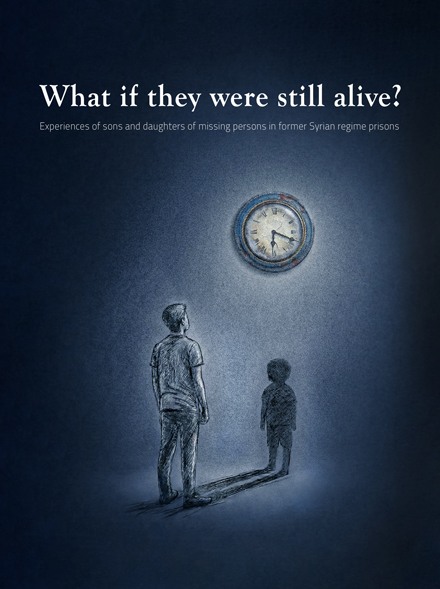
Generally, most studies on Syrian missing persons tend to focus on quantitative data and a documentation perspective. These studies aim at accounting for the number of missing persons, documenting cases of detention and recording violations associated with forced disappearance. This approach offers a comprehensive picture of the quantitative scope of the phenomenon. However, it falls short of understanding the human and social experience of the children and families especially in terms of their perception of time and the meaning of waiting and how they deal with absence. Most of those studies were based on a human rights perspective focused on collecting evidence and documenting violations (including the few qualitative studies that attempted to offer in-depth understanding of the experience of missing persons by paying special attention to the psychological- therapeutic aspects). This human rights focus makes enforced disappearance appear to be a matter of numbers and rights while, for the families in reality, it is an experience which is repeated every day in their memory and relations reshaping the personal and social time of the family as time itself becomes a social space where absence is reformulated as a continuous action that is not forgotten but brought back through daily practices and political memory to the present making it a living experience which infiltrates the details of daily life. Hence, it is important to look at time not merely as a neutral background for events, but a structural element which is reshaped within the experiences of forced absence. Waiting, suspension, repetition and lack of closure all create a new social time shared by the children, the family and the community at large. This “fractured time” is not a mere detail. Rather, it is a structural factor that reformulates identity, relations, responsibilities and future outlook. Without understanding this time, the experience remains lacking and disrupted. This pattern of dealing with absence shows that time in the context of forced absence does not operate as a pathway for progress, but as a mechanism to reproduce social vulnerability. The families live in fractured time where the future retracts under the weight of a lingering past. This in turn reflects on the prospects of social recovery and building trust in the present. In the literature, this absence does not only reflect a knowledge gap, but reveals a structural gap in legal and political fields unless mechanisms are put in place to understand the impact of absence on the social time and shaping roles within the family and the emotional shifts between the past and the present.
To read the full report, please click here
ADMSP
26-6-2026
Damascus – Syria